

Can BNC Male Crimp Connectors be used in fiber - optic systems?
As a supplier of BNC Male Crimp Connectors, I often encounter inquiries from customers regarding the compatibility of these connectors with fiber - optic systems. This topic is crucial as it can significantly impact the performance and reliability of communication networks. In this blog, I will delve into the technical aspects to determine whether BNC Male Crimp Connectors can be used in fiber - optic systems.

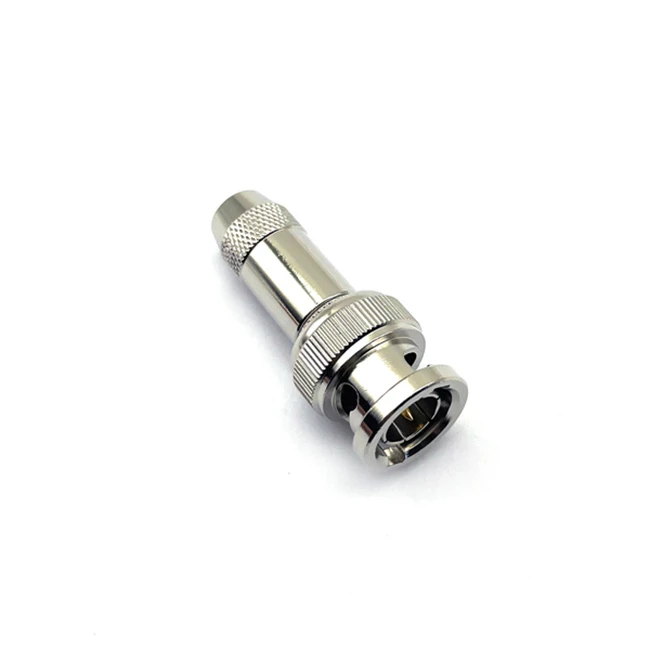
Understanding BNC Male Crimp Connectors
BNC (Bayonet Neill - Concelman) connectors are a type of RF (Radio Frequency) coaxial connector. They are known for their quick - connect and disconnect feature, which is achieved through a bayonet - style coupling mechanism. BNC Male Crimp Connectors are designed to be attached to coaxial cables by crimping. This process involves using a special tool to deform the connector onto the cable, creating a secure and electrically conductive connection.
We offer a variety of BNC Male Crimp Connectors, such as the BNC Male CONNECTOr for 3C - 2V Cable BNC - J2 and the 75ohm BNC Male Connector for RG6 Cable Crimp Type BNC - C - 75J5. These connectors are widely used in applications like CCTV systems, test equipment, and radio communication due to their excellent RF performance and ease of installation.
The Basics of Fiber - Optic Systems
Fiber - optic systems use thin strands of glass or plastic, known as optical fibers, to transmit data in the form of light signals. These systems offer several advantages over traditional copper - based systems, including higher bandwidth, longer transmission distances, and immunity to electromagnetic interference.
Fiber - optic connectors are specifically designed to couple optical fibers together or to connect fibers to other optical components. They need to ensure precise alignment of the fibers to minimize signal loss and maintain high - quality transmission. Common types of fiber - optic connectors include SC, LC, ST, and MPO connectors.
Technical Incompatibility between BNC Male Crimp Connectors and Fiber - Optic Systems
- Transmission Medium Mismatch
- BNC Male Crimp Connectors are designed for coaxial cables, which transmit electrical signals. Coaxial cables consist of a central conductor, an insulating layer, a metallic shield, and an outer jacket. In contrast, fiber - optic cables transmit light signals through the core of the fiber. The fundamental difference in the transmission medium means that BNC connectors cannot be directly used to connect fiber - optic cables.
- Signal Conversion Requirements
- Since BNC connectors handle electrical signals and fiber - optic systems use light signals, a conversion process is needed. This requires the use of transceivers or media converters to convert electrical signals to light signals and vice versa. BNC connectors do not have the built - in capability to perform such conversions, so they cannot be directly integrated into fiber - optic systems without additional equipment.
- Physical Design and Alignment
- Fiber - optic connectors require extremely precise alignment to ensure that light signals can be efficiently transmitted from one fiber to another. BNC connectors are not designed to provide this level of precision for fiber alignment. The mechanical structure of BNC connectors is optimized for coaxial cable connections, not for the delicate alignment requirements of fiber - optic connections.
Exceptions and Special Cases
In some hybrid systems, where both coaxial and fiber - optic components are used, there may be a need to interface between the two. For example, in a large - scale surveillance system, some cameras may be connected via coaxial cables with BNC connectors, while the long - distance transmission to the central monitoring station is done through fiber - optic cables. In such cases, media converters can be used to bridge the gap between the BNC - connected coaxial section and the fiber - optic section of the system.
Applications of BNC Male Crimp Connectors
Despite their inapplicability in direct fiber - optic connections, BNC Male Crimp Connectors have a wide range of other applications. They are commonly used in:
- CCTV Systems
- Many closed - circuit television cameras are connected to monitors or recording devices using coaxial cables with BNC connectors. The quick - connect feature of BNC connectors makes installation and maintenance of these systems relatively easy.
- Test and Measurement Equipment
- In laboratories and testing facilities, BNC connectors are used to connect various test equipment, such as oscilloscopes, spectrum analyzers, and signal generators. They provide a reliable and standardized way to transfer RF signals for accurate measurements.
- Radio Communication
- BNC connectors are often used in radio transceivers, antennas, and other radio communication equipment. They can handle a wide range of RF frequencies and are suitable for both indoor and outdoor applications.
Conclusion
In conclusion, BNC Male Crimp Connectors cannot be directly used in fiber - optic systems due to the fundamental differences in transmission medium, signal type, and physical design. However, in hybrid systems, with the help of media converters, they can be part of a larger network that includes both coaxial and fiber - optic components.
If you are in need of high - quality BNC Male Crimp Connectors for your coaxial - based applications, we are here to serve you. Our products, like the BNC Male CONNECTOr for 3C - 2V Cable BNC - J2 and 75ohm BNC Male Connector for RG6 Cable Crimp Type BNC - C - 75J5, are designed to meet the highest standards of quality and performance. We also offer BNC Female Cap with Chain for protecting your BNC connectors when not in use.
If you have any questions or would like to discuss your specific requirements for BNC Male Crimp Connectors, please feel free to contact us for procurement and further discussion.
References
- "Coaxial Cable Handbook" by ARRL
- "Fiber - Optic Communication Systems" by Govind P. Agrawal