

In the realm of RF (Radio Frequency) technology, the BNC male connector for RG58 cable is a crucial component that plays a significant role in various applications. As a supplier of BNC male connectors for RG58, I often encounter questions about the impedance of these connectors. In this blog post, I will delve into the concept of impedance, explain what the impedance of a BNC male connector RG58 is, and discuss its importance in RF systems.
Understanding Impedance
Before we dive into the impedance of the BNC male connector RG58, it's essential to understand what impedance is. In electrical engineering, impedance is a measure of the opposition that a circuit presents to the flow of alternating current (AC). It is a complex quantity that includes both resistance (which dissipates energy) and reactance (which stores and releases energy). Impedance is measured in ohms (Ω) and is represented by the symbol Z.
In RF systems, impedance matching is crucial for efficient power transfer and signal integrity. When the impedance of a source (such as a transmitter) matches the impedance of a load (such as an antenna or a receiver), maximum power is transferred from the source to the load, and reflections are minimized. If the impedance is not matched, some of the power is reflected back to the source, which can cause signal degradation, interference, and reduced system performance.
Impedance of BNC Male Connector RG58
The BNC male connector for RG58 cable typically has an impedance of 50 ohms. RG58 is a type of coaxial cable that is commonly used in RF applications, such as amateur radio, test equipment, and networking. Coaxial cables consist of a central conductor surrounded by a dielectric insulator, a metallic shield, and an outer jacket. The impedance of a coaxial cable is determined by the ratio of the outer conductor diameter to the inner conductor diameter and the dielectric constant of the insulator.

The 50-ohm impedance standard is widely used in RF systems because it provides a good compromise between power handling capacity and signal loss. At 50 ohms, coaxial cables can handle relatively high power levels while maintaining low signal attenuation over long distances. This makes them suitable for a wide range of applications, from low-power communication systems to high-power transmitters.
The BNC (Bayonet Neill-Concelman) connector is a type of RF connector that is known for its quick and easy connection and disconnection. It uses a bayonet-style coupling mechanism that provides a secure and reliable connection. The BNC male connector has a center pin that connects to the central conductor of the RG58 cable and a outer shell that connects to the metallic shield. The impedance of the BNC male connector is designed to match the impedance of the RG58 cable, typically 50 ohms, to ensure efficient power transfer and signal integrity.
Importance of Impedance Matching
As mentioned earlier, impedance matching is crucial in RF systems. When using a BNC male connector RG58, it is essential to ensure that all components in the system have the same impedance, typically 50 ohms. This includes the source, the cable, the connector, and the load. If the impedance is not matched, reflections can occur at the interfaces between the components, which can cause signal degradation, interference, and reduced system performance.
For example, if a 50-ohm BNC male connector is connected to a 75-ohm load, some of the power will be reflected back to the source. This can cause standing waves on the cable, which can increase the voltage and current levels at certain points along the cable. In extreme cases, this can lead to damage to the components or the cable. To avoid these issues, it is important to use components with the same impedance and to ensure that the connections are properly made.
Applications of BNC Male Connector RG58
The BNC male connector RG58 is used in a wide range of RF applications, including:
- Amateur Radio: RG58 cable with BNC connectors is commonly used in amateur radio setups to connect transceivers to antennas, antennas to tuners, and other components in the radio system. The 50-ohm impedance of the BNC male connector and the RG58 cable ensures efficient power transfer and signal integrity, which is essential for clear communication.
- Test Equipment: In test and measurement applications, RG58 cable with BNC connectors is often used to connect test equipment, such as oscilloscopes, spectrum analyzers, and signal generators, to the devices under test. The quick and easy connection and disconnection of the BNC connectors make them convenient for testing and troubleshooting.
- Networking: In some networking applications, RG58 cable with BNC connectors can be used for short-distance connections, such as between network devices or in legacy Ethernet networks. However, with the advancement of networking technology, other types of cables, such as twisted pair and fiber optic cables, are more commonly used in modern networks.
Related Products
As a supplier of BNC male connectors for RG58, we also offer a variety of related products, including:
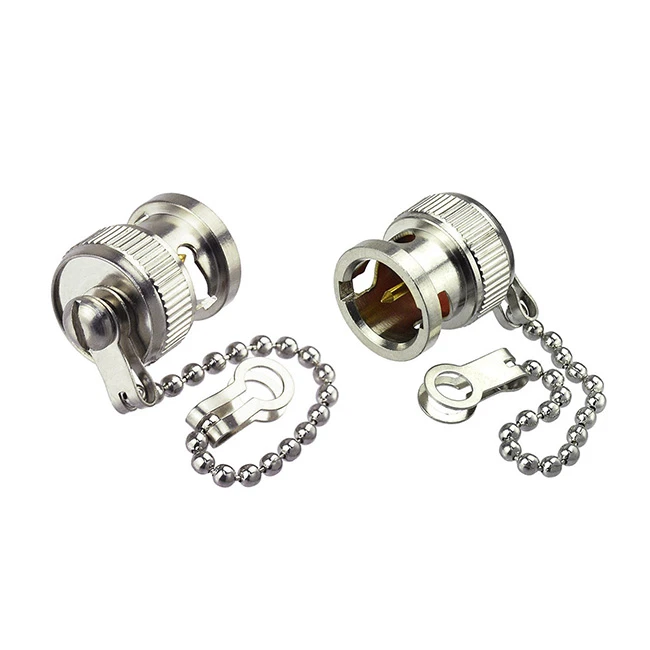
- BNC Female Cap with Chain: This product is used to protect the female end of a BNC connector when it is not in use. The chain ensures that the cap is not lost and can be easily attached and detached.
- RF Connector BNC Male for RG6/5D-2V Cable Clamp Type BNC-C-J5-2-1: This is another type of BNC male connector that is suitable for RG6 or 5D-2V cables. It uses a clamp-type termination method, which provides a secure and reliable connection.
- RF Connector BNC Male Right Angle for RG58 Cable Crimp Type BNC-C-JW3: This right-angle BNC male connector is designed for RG58 cable and uses a crimp-type termination method. It is useful in applications where space is limited or where a right-angle connection is required.
Contact for Procurement
If you are interested in purchasing BNC male connectors for RG58 or any of our related products, please feel free to contact us for more information and to discuss your specific requirements. We are committed to providing high-quality products and excellent customer service. Our team of experts can assist you in selecting the right products for your application and ensuring that you get the best value for your money.
References
- "RF and Microwave Coupling Circuits" by Guillermo Gonzalez
- "Coaxial Cable Basics" by Tech-FAQ
- "BNC Connector Guide" by Amphenol Corporation