

Contact resistance is a crucial parameter in the performance evaluation of RF connectors, including MCX connectors. As a supplier of MCX connectors, understanding the concept of contact resistance and its implications is essential for providing high - quality products to our customers.
What is Contact Resistance?
Contact resistance refers to the resistance that occurs at the interface between two conductive materials when they are in contact. In the context of MCX connectors, it is the resistance encountered when the male and female parts of the connector are mated. This resistance is not a fixed value but is influenced by several factors, including the materials used, the surface finish, the contact force, and the presence of contaminants.
The contact resistance in an MCX connector can be divided into two main components: constriction resistance and film resistance. Constriction resistance is caused by the fact that the actual contact area between two mating surfaces is much smaller than the apparent contact area. When current flows through the contact interface, it has to pass through these small contact spots, which results in a constriction of the current path and thus an increase in resistance.
Film resistance, on the other hand, is due to the presence of thin films on the contact surfaces. These films can be formed by oxidation, corrosion, or the deposition of contaminants. Oxide films, for example, are poor conductors, and their presence can significantly increase the contact resistance. Even a very thin oxide layer can have a substantial impact on the electrical performance of the connector.
Factors Affecting the Contact Resistance of MCX Connectors
Material Selection
The choice of materials for the contact parts of MCX connectors plays a vital role in determining the contact resistance. Metals with high electrical conductivity, such as copper and its alloys, are commonly used for the inner conductors of MCX connectors. These materials offer low resistance and good current - carrying capabilities.
For the outer conductors, materials like brass or stainless steel are often employed. The surface of these conductors may be plated with materials such as gold, silver, or tin to improve their conductivity and corrosion resistance. Gold plating, in particular, is highly valued for its excellent conductivity, resistance to oxidation, and low contact resistance. It provides a stable and reliable contact surface, even in harsh environments.
Surface Finish
The surface finish of the contact parts is another important factor. A smooth and clean surface reduces the constriction resistance by increasing the effective contact area. During the manufacturing process, the contact surfaces are carefully polished to achieve a high - quality finish. Any roughness or irregularities on the surface can lead to a decrease in the contact area and an increase in resistance.
In addition to mechanical polishing, chemical treatments may also be applied to the contact surfaces. These treatments can remove any contaminants or oxide layers and improve the surface properties. For example, a passivation treatment can form a protective layer on the surface, preventing further oxidation and reducing the film resistance.
Contact Force
The contact force between the male and female parts of the MCX connector is critical for maintaining a low contact resistance. A sufficient contact force ensures that the mating surfaces are in close contact, reducing the constriction resistance. When the contact force is too low, the contact area may be insufficient, leading to an increase in resistance.
However, excessive contact force can also cause problems. It may damage the contact surfaces, leading to deformation or wear. Therefore, during the design and manufacturing of MCX connectors, the contact force is carefully optimized to ensure a balance between low resistance and long - term reliability.
Environmental Conditions
Environmental factors such as temperature, humidity, and the presence of contaminants can have a significant impact on the contact resistance of MCX connectors. High temperatures can accelerate the oxidation process, leading to an increase in film resistance. Humidity can also promote corrosion, especially if the connector is not properly protected.
Contaminants such as dust, dirt, and chemicals can accumulate on the contact surfaces, increasing the resistance. In industrial or outdoor applications, where the connectors are exposed to harsh environments, special protective measures may be required to maintain a low contact resistance.
Measuring the Contact Resistance of MCX Connectors
Accurately measuring the contact resistance of MCX connectors is essential for quality control and performance evaluation. There are several methods available for measuring contact resistance, including the four - wire method and the two - wire method.
The four - wire method, also known as the Kelvin method, is the most accurate way to measure contact resistance. In this method, two current - carrying wires are used to pass a known current through the connector, and two voltage - sensing wires are used to measure the voltage drop across the contact interface. By using separate current and voltage paths, the resistance of the measurement leads is eliminated, resulting in a more accurate measurement of the contact resistance.
The two - wire method is simpler but less accurate. In this method, the same two wires are used to carry the current and measure the voltage. The resistance of the measurement leads is included in the measurement, which can introduce errors, especially when the contact resistance is very low.
Impact of Contact Resistance on the Performance of MCX Connectors
The contact resistance of MCX connectors can have a significant impact on their electrical performance. High contact resistance can lead to power losses, signal attenuation, and increased noise.
Power losses occur because the electrical energy is dissipated as heat at the contact interface. This not only reduces the efficiency of the connector but also generates heat, which can further increase the contact resistance and potentially damage the connector.
Signal attenuation is another problem caused by high contact resistance. When a signal passes through a connector with high resistance, its amplitude is reduced, leading to a loss of information. This can be particularly problematic in high - frequency applications, where even a small amount of attenuation can have a significant impact on the signal quality.
In addition, high contact resistance can increase the noise level in the system. The resistance fluctuations at the contact interface can introduce random noise into the signal, degrading the signal - to - noise ratio.
Our MCX Connector Products and Contact Resistance
As a supplier of MCX connectors, we are committed to providing products with low contact resistance and high performance. Our MCX Connector Male To Male Adaptor MCX - JJ is designed with high - quality materials and advanced manufacturing processes to ensure a low contact resistance. The inner conductors are made of high - conductivity copper alloys, and the contact surfaces are gold - plated for excellent conductivity and corrosion resistance.
Our MCX Female Connector Micro - Strip Type MCX - KFD also features a carefully designed contact structure to minimize the contact resistance. The surface finish of the contact parts is optimized to increase the effective contact area, and the contact force is precisely controlled to ensure a stable and reliable connection.
Similarly, our MCX Male Connector Right Angle PCB Mount MCX - JWE is engineered to provide a low - resistance connection. The right - angle design allows for easy installation on PCBs, while the high - quality contact materials and surface treatments ensure a low contact resistance, even in high - frequency applications.
Conclusion
Contact resistance is a critical parameter in the performance of MCX connectors. Understanding the factors that affect contact resistance and taking appropriate measures to control it are essential for ensuring the reliability and performance of these connectors. As a supplier, we are dedicated to producing MCX connectors with low contact resistance, using the latest technologies and high - quality materials.

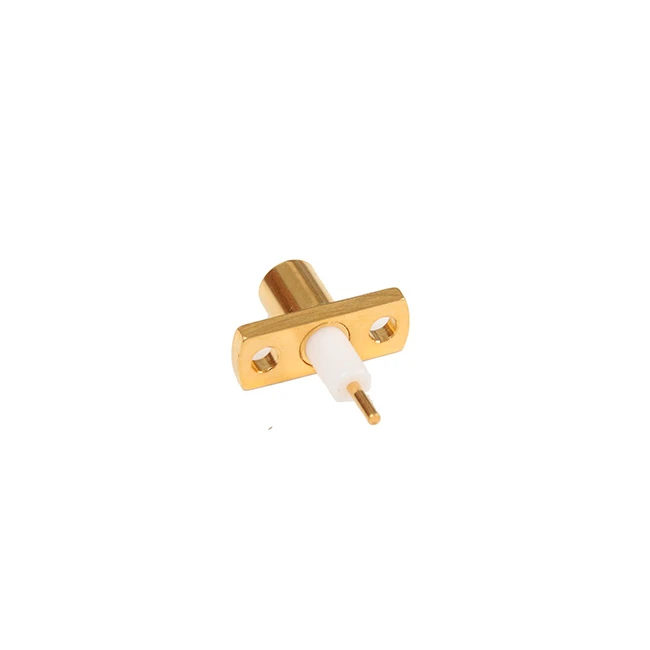
If you are interested in our MCX connector products or have any questions about contact resistance, please feel free to contact us for procurement and further discussions. We are looking forward to serving you and meeting your specific requirements.
References
- Grover, F. W. (1962). Inductance Calculations: Working Formulas and Tables. Dover Publications.
- Ramo, S., Whinnery, J. R., & Van Duzer, T. (1994). Fields and Waves in Communication Electronics. John Wiley & Sons.
- IEC 61169 - 1:2018, Radio - frequency connectors - Part 1: General requirements and measuring methods.